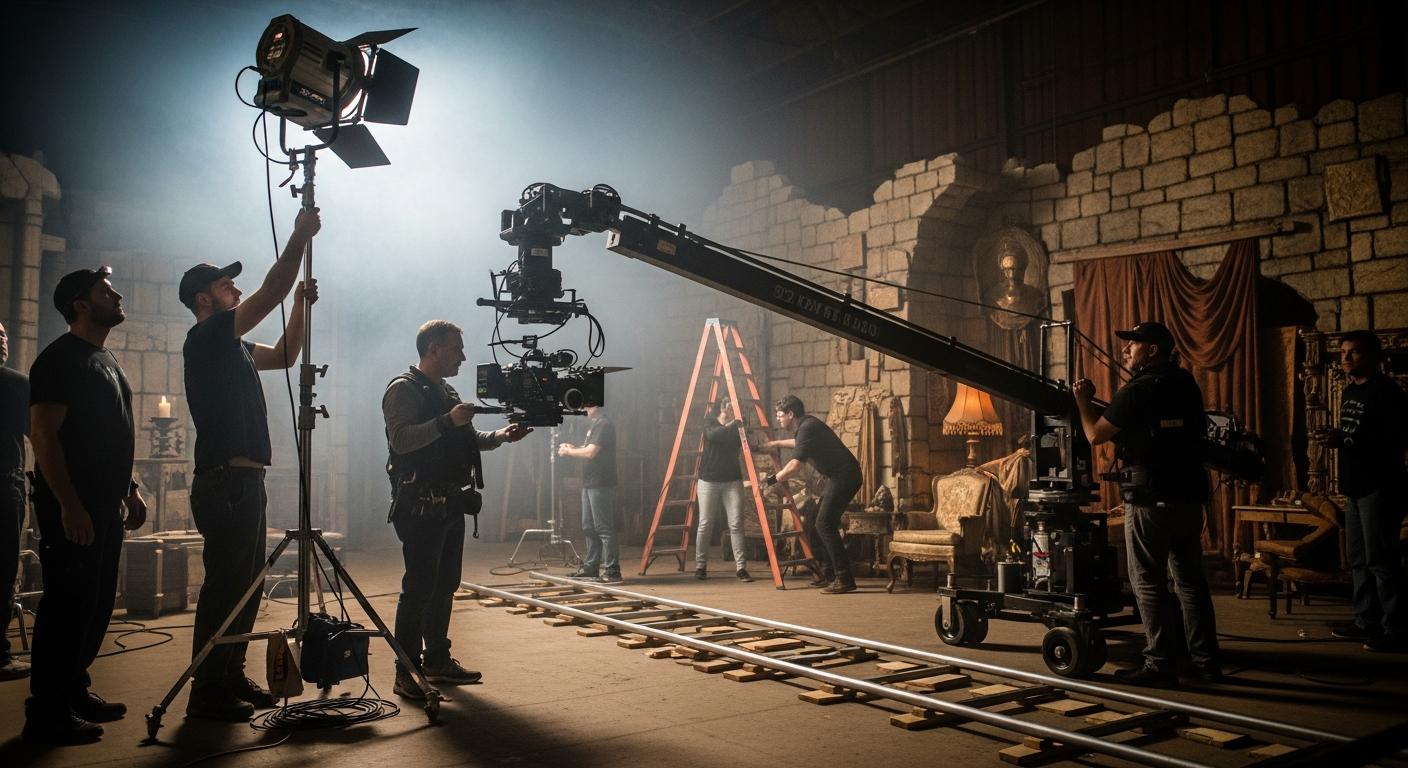
The Production Pipeline Is Broken
I've been thinking about this since a conversation with a producer in Nairobi. She spent her entire morning looking for a three-paragraph brief. And she laughed about it, because that's just how production works now.
I've been thinking about this since a conversation I had with a producer in Nairobi a few weeks back. She runs a solid operation there, ten years in, good clients, good team. She spent most of her morning trying to find a brief. Not writing one, not reviewing one, just locating it. It had been split across a Slack thread, a couple of email chains, and a Google Doc with the wrong sharing permissions. She finally tracked it down close to noon. Three paragraphs. That's all it was, three paragraphs, and it ate her entire morning. She laughed when she told me, the way you laugh when you've stopped being surprised by something that should be unacceptable. "I didn't get into this to be a professional file hunter," she said, and I recognised that particular exhaustion immediately because I've felt it on every continent I've worked in.
The thing is, most of us in production have accepted this as the cost of doing business. More than half the working day goes to admin, chasing, coordinating, switching between apps, all the work that surrounds the actual work. We know this. We complain about it at wrap parties and in hotel lobbies and then we go back to the same broken process on Monday.
Where briefs go wrong
The brief is supposed to be the foundation. One document that aligns everyone, client, creative team, producers, talent. In practice, most agencies still manage briefs through email, which is a bit like using a filing cabinet as a collaboration tool. Version control becomes "the one I sent on Thursday," and approval becomes "I think Sarah said it was fine on that call." Some shops don't write briefs down at all. Verbal, over coffee. "Just make it punchy, you know what we mean."
Then scope creep sets in, as it always does. A two-platform campaign quietly becomes five. The corporate video grows a BTS component, three social cutdowns, and a 30-second version for the CEO's keynote that nobody mentioned until week four. By the time anyone notices, the budget's blown and everyone's pointing fingers because nobody can agree on what was originally agreed. This isn't a people problem. It's an infrastructure problem, we simply don't have systems that capture and enforce what was signed off before the work starts.
Scheduling by spreadsheet and memory
I asked a studio manager recently how she schedules resources, edit suites, grading rooms, crew, equipment. She showed me a Google Sheet with colour-coded cells. Pink for tentatively booked, yellow for confirmed but might change, green for locked. There was also a light blue that meant "complicated, ask me verbally." This is a studio billing six figures a month.
Every team I've worked with runs the same way. They're doing what that studio manager does, running a spreadsheet, keeping half of it in their head, hoping the two don't contradict each other on the wrong day. When it goes wrong, and it goes wrong regularly, the cost is serious. A shoot day on a decent commercial can run anywhere from $50K to $500K depending on the market and the scale. One idle day because the gaffer got double-booked or the location release didn't come through, that money doesn't come back. And for agencies running twenty-plus projects at once, one scheduling conflict creates dominoes across the entire book of work.
Post-production and the organisational tax
Post should be where the craft lives. Raw footage becomes story, performances get shaped, colour and sound turn something competent into something that makes people feel things. Instead, an enormous amount of post time goes to organising, finding, sorting, re-conforming. Jason Krane, a dialogue editor with well over a hundred IMDb credits, put it in a way that stuck with me: much of the editing is organisational now, getting the tracks to a place where you can actually edit, and the actual creative side of editing has become minimal. That's from someone who's been doing this longer than most of us.
Every handoff in post, editorial to VFX to colour to sound to online to QC, is a chance for something to break. Versions get confused. Notes from the last round vanish. Someone's working from the wrong cut. Once VFX starts on a sequence, changes to the underlying footage become astronomically expensive, but late client notes demanding exactly those changes happen on nearly every job.
Approvals
You send a cut for review. Silence. Days, sometimes weeks. You follow up gently because you can't afford to annoy the client. When feedback finally arrives, it's scattered across an email thread, a few Slack messages, a WhatsApp voice note, and something someone half-remembers from a call that wasn't recorded. Most of the feedback isn't even actionable. "Make it more dynamic." "Can we try something fresher?" "It doesn't feel premium enough." You do another round anyway.
And then someone requests changes that contradict what a colleague already approved. That happens constantly, on nearly every project I've been part of in the last five years. It's not iteration. It's miscommunication dressed up as process.
Delivery complexity
One piece of content now needs to exist as a 16:9 master, a 9:16 vertical, a 1:1 square, a 4:5 for feed, a 15-second cutdown, a 6-second bumper, separate versions for YouTube and Instagram and TikTok (which changes its specs every few months) and Facebook and possibly a broadcast version if there's TV budget. Subtitled versions. Possibly dubbed. The deliverables list on a mid-range campaign can run to forty or fifty items, each with its own codec, resolution, and platform-specific requirements.
Connected TV now accounts for a larger share of viewing than broadcast and cable combined. Every new platform is another deliverable to produce, QC, and track, and budgets have been shrinking year on year. More output, more platforms, less money. The maths doesn't work, but nobody's solved the equation yet, so we just keep absorbing the pressure.
Too many tools, no integration layer
We have tools. Loads of them. Project management platforms, review tools, DAMs, MAMs, spreadsheets for budgets, cloud drives for files, Slack for when things are on fire. The average creative team uses somewhere between ten and fifteen different tools per project, and they don't talk to each other in any meaningful way. So every time work moves between stages, brief to planning, production to post, edit to review, review to delivery, someone has to manually carry the context across. Copy the notes, re-upload the file, update the spreadsheet, send the email saying "I've updated the spreadsheet."
And here's the counterweight, because it's worth saying: many of these individual tools are genuinely good at their specific job. Monday.com handles project management competently. Bynder is solid for brand assets. The individual tools aren't the problem. Nobody has built the thing that lets all the stages talk to each other without a human doing the translation work in between.
What people actually want
I've spent months talking to producers, post supervisors, studio managers, agency heads, freelancers. The frustration is remarkably consistent regardless of company size or vertical. They don't want another tool. They want one place where the brief, the assets, the feedback, the timeline, and the budget coexist. Where the budget updates when you log an expense, not three days later when someone remembers. Where a client can leave timecoded feedback without needing a separate account on a separate platform. I keep coming back to the same frustration, and it's always at the point where work crosses from one stage to the next.
We've been building something at Telova that tries to close those gaps, but that's a conversation for another post.